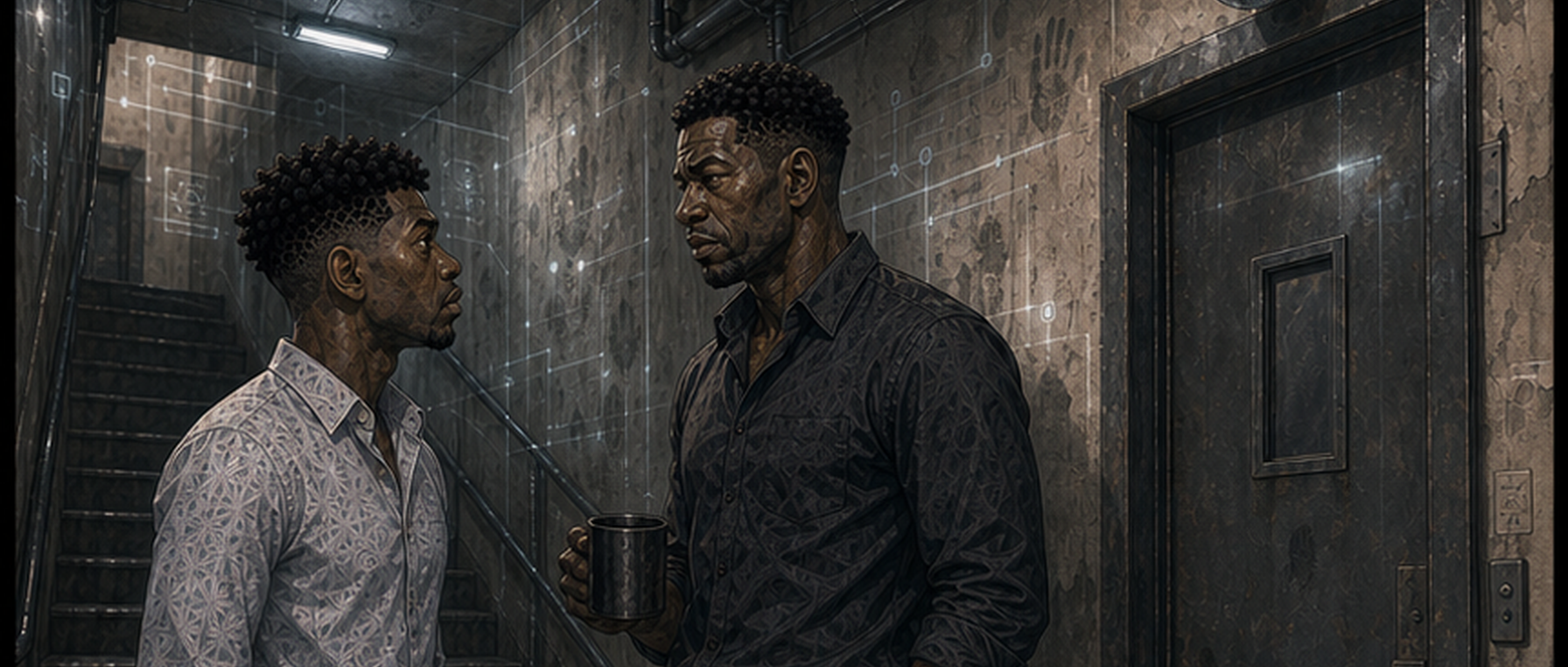
Sizwe's Rule
Zeth Mnguni - Genesis
Chapter 5: Sizwe's Rule
There were documents written to be read, and there were documents written to make reading feel like punishment.
The Apex Sentinel Secure Development Guidelines belonged to the second family.
Version 4.7 sat open on Zeth's monitor with the clean arrogance of a thing no one had ever loved. It had headings. It had subheadings. It had diagrams with arrows pointing to boxes, and boxes pointing to smaller boxes, and footnotes that sent him to appendices where the same point had been restated with less mercy.
Page forty-two explained escalation handling.
Page forty-three explained escalation handling in exceptional circumstances.
Page forty-four explained how exceptional circumstances were not to be treated as exceptional unless approved by a person with sufficient authority to classify them as exceptional.
Zeth read the sentence twice.
Then he read it a third time because maybe the second time he had become stupid.
On the other side of the desk island, Ruan Bekker was deep in his own fight with an export function that had taken personal offence at apostrophes.
He had one hand in his hair and the other on the keyboard, his face arranged in a kind of private mourning.
"Bad news," Ruan whispered without turning.
Zeth did not look away from the guidelines.
"I am not available for bad news."
"The system accepts Van Rensburg."
"Congratulations to the system."
"It accepts Mokoena."
"We are all proud."
"It accepts Naidoo."
"You are going to tell me something racist is happening."
"No. Worse. It crashes on O'Connell."
Zeth looked at him.
Ruan's eyes were bright with offended scholarship.
"An Irish person broke Africa's future."
Zeth tried not to smile.
He failed by a millimeter.
Ruan saw it and looked pleased with himself.
"There he is."
"Fix only the crash," Zeth said, mimicking Mira's tone.
Ruan put a hand to his chest.
"Respectfully, still rude."
The laugh almost came out of Zeth before he remembered the morning.
The lost ticket.
The vanished branch.
The locked folder.
Mira's hand on the mouse.
Forget what you saw.
The laugh retreated.
He turned back to page forty-four.
The document spoke about Role-Based Access Control in the voice of a principal who could smell untucked shirts through a wall.
Zeth read the definition of a role.
Then the definition of a group.
Then the definition of a permission.
Then the definition of a user, as if the company was not entirely sure people existed until policy had agreed to them.
He tried to focus.
He was good at focus. Focus had been one of the first things the academy beat into him without leaving a mark anyone could complain about. Focus through hunger. Focus through noise. Focus while an instructor shouted two centimeters from your ear and dared your eyes to move.
Academy body.
He could sit still. He could keep his face neutral. He could make the body obey.
But his mind would not stop walking back to the same locked door.
`archive_legacy_reader`
`CIVIC-BBX`
`R_NKOSI.watch`
He had not written the last one down.
That did not make it safer.
It was worse in his head. His notebook at least had paper between it and the world. His head carried things naked.
Mira passed behind him once.
She did not stop.
She did not look at his screen.
She did not need to.
Zeth felt her attention land between his shoulder blades and stay there for four full steps after she had gone.
Ruan rolled his chair closer again.
"You know," he whispered, "in private school, if someone made you read a policy document for discipline, they had to call it character development."
"At the academy they just called it Tuesday."
Ruan glanced over.
The joke had come too fast.
Zeth knew that look already. It was not pity. Ruan did not know him well enough to pity him properly. It was curiosity wrapped in manners.
"Tuesday sounds hectic where you are from," Ruan said.
"You should see Wednesday."
Ruan gave a quiet huff and rolled back to his keyboard.
Zeth kept reading.
By page fifty-nine he had discovered that Apex Sentinel did not believe in mistakes. It believed in incidents, deviations, escalations, process failures, remedial actions, and retrospective alignment.
Mistake was too human.
Mistake had fingerprints.
At eleven thirty-two, an email arrived from Nandi Mthembu reminding all interns that lunch was from twelve to one, unless department requirements differed, and that attendance at the afternoon compliance briefing was compulsory.
Ruan read it and lifted both eyebrows.
"Lunch exists. HR has confirmed."
Zeth did not reply.
He was rereading a paragraph about audit trails.
The system must preserve a non-repudiable record of user activity where technically feasible and operationally mandated.
It was one of those sentences that sounded clean until you noticed the escape hatch.
Where technically feasible.
Operationally mandated.
Two little doors left open in a sentence about closing doors.
"Mnguni."
Sizwe Khumalo's voice came from behind him.
Zeth turned.
Sizwe stood with his old coffee mug in one hand and a lanyard looped around two fingers. He looked the same as he had all morning: tired but not weak, calm but not relaxed. His shirt sleeves were rolled with the precision of a man who had done the same thing for years and had stopped thinking about it.
"Coffee," Sizwe said.
It did not sound like a question.
Zeth looked at the guidelines.
"Mira told me to read."
"I am your supervisor."
"She looked serious about it."
"Mira always looks serious about things. It is one of the pillars holding this building up."
Ruan made a small sound into his fist.
Sizwe looked at him.
"Mr Bekker."
"Sir."
"If the apostrophe defeats you while I am gone, do not let it take the rest of the codebase hostage."
"Understood."
Sizwe looked back at Zeth.
"Coffee."
Zeth locked his computer, closed his notebook into the gap between his keyboard and monitor, and stood.
Mira watched from three desks away.
Sizwe saw her watching.
Neither of them changed expression.
That was how Zeth knew the coffee was not about coffee.
The Apex cafeteria occupied a glass corner of the seventh floor, as if even lunch had to understand branding. Below, Johannesburg pushed into the afternoon in layers of traffic, construction dust, taxi-yellow flashes, and the silver glint of office towers trying to make the city look more certain than it was.
The cafeteria smelled like burnt espresso, hot oil, and expensive furniture.
On one wall, a muted television carried rolling news with subtitles. Parliament footage played behind a headline about the State Records Protection Bill. Men in suits leaned toward microphones. A woman in a red jacket spoke with her hand raised. Below her, the line crawled:
Journalist groups warn bill may endanger whistleblowers
Zeth's eyes caught on the word journalist.
Then on whistleblowers.
Then he looked away before looking away became evidence.
Sizwe took two coffees from the counter, paid with his employee card, and placed one in front of Zeth at a small table near the window.
"Do you take sugar?"
"No."
Sizwe sat.
"Good."
"Because sugar is bad?"
"Because I already paid."
Zeth lifted the cup.
The coffee was strong enough to make a weaker man admit secrets.
Sizwe watched him take the first sip.
"You finished the asset ticket quickly."
Zeth kept the cup near his mouth.
"It was not complicated."
"Most things that break systems are not complicated."
Zeth put the cup down.
Sizwe leaned back.
"Tell me what you saw."
The cafeteria noise softened around them. Cutlery. Shoes. A laugh from a table of analysts. The hiss of milk behind the counter.
Zeth thought of Mira.
Forget what you saw.
"I saw an old log line," he said.
"Which said?"
"Inherited role not found in active profile."
"And?"
"A temporary permission issue."
Sizwe's mouth did not move, but Zeth felt the correction before it came.
"That is an answer for a form."
Zeth said nothing.
"I did not ask for the form answer."
The television moved from Parliament to a studio panel. A caption named one of the guests as a senior executive from Duma Genesis Technologies. Diego Duma was not on screen, but the logo sat in the corner behind the anchor, clean and proud.
Zeth did not look at it.
"If a user has no active role," Sizwe said, "but a folder opens for him anyway, where do you look first?"
Zeth felt the shape of the question settle into him.
This was not a trap.
Or it was a better kind of trap.
"Depends on how the system resolves access."
"Everything depends. Choose."
"I look at direct permissions first. Then group membership. Then inherited roles. Then cached tokens. Then service accounts. Then defaults set during migration. Then failed deny rules. Then anything marked temporary, because temporary is where permanent goes to hide."
Sizwe watched him.
Zeth regretted the last sentence.
It sounded too much like himself.
"And if the folder appears, then disappears?"
"Someone removed access."
"A person?"
"Or a process."
"Which one do you trust?"
"Neither."
For the first time, Sizwe looked almost pleased.
"Good."
Zeth wrapped both hands around the coffee cup. The heat bit his palms and gave his body something clean to understand.
Sizwe said, "Most juniors choose one answer too quickly. Person or process. Malice or bug. You did not."
"Bugs can be malice with a deadline."
Sizwe's eyes sharpened.
It was small. A tightening. A light switching behind old glass.
"Who taught you to say things like that?"
"No one."
"That is rarely true."
"Then I do not remember."
Sizwe looked at him for a long second.
On the television, the panel changed again. Another subtitle crawled by:
Opposition demands transparency on archive-security tenders
Sizwe did not look at the screen.
"Where did you learn systems design?"
Zeth gave the answer that had kept doors open and conversations clean.
"Duma Foundation Academy."
Sizwe's face did not change enough for a stranger to notice.
Zeth noticed.
It was like watching a man step on glass under a carpet.
"The academy," Sizwe said.
"Yes."
"How long?"
"From twelve."
"Scholarship intake?"
"Yes."
"Parents?"
Zeth's hand tightened around the cup.
The coffee moved.
Not much.
Enough.
Sizwe looked at the ripple and then at Zeth's face.
"Sorry," he said.
It was a strange apology because it sounded real.
That made Zeth distrust it more.
"They died," Zeth said.
He used the short version because the long version belonged to police files, news clippings, half-remembered rooms, and adults who used soft voices while taking inventory of what a child had lost.
Sizwe nodded once.
"Your surname is Mnguni."
"It is."
"Menzi?"
Zeth set the cup down too carefully.
"Why?"
Sizwe did not answer immediately.
For a moment, he was not looking at Zeth.
He was looking at something much further away, something that had happened before Apex built glass cafeterias and branded elevators and rules about escalation handling.
"I knew a Menzi Mnguni," Sizwe said.
The cafeteria did not change.
People still queued for food.
Someone complained about the curry.
The television still spoke silently about a bill that would decide what the country was allowed to know.
But Zeth felt the table become smaller.
"A lot of people knew my father after he died," Zeth said.
The edge in his voice arrived before permission.
Sizwe accepted it.
"I knew him before."
Zeth waited.
Sizwe looked down at his coffee.
"Not well enough."
That was not the answer Zeth expected.
He had expected distance. Defensiveness. The familiar arrangement of adult guilt into something useless but polite.
Not well enough sounded like a wound he had not been invited to touch.
"Where?" Zeth asked.
"University, briefly. Later through contract work. He was not the easiest man to forget."
Zeth's throat tightened.
He hated how quickly the body betrayed him with old names.
"People say that when they mean difficult."
"He was difficult."
Zeth looked away.
Sizwe added, "He was also usually right."
That brought Zeth back.
"About what?"
Sizwe's thumb moved along a stain on the side of his mug. Old coffee had darkened a thin crack near the handle.
"Systems."
Zeth almost laughed, but there was no humor in it.
"That is broad."
"He liked broad things. People tried to give him small problems because they thought that would keep him manageable. He would solve the small problem, then show them the bigger one hiding behind it."
Zeth knew that feeling.
Not as memory.
As inheritance.
He looked at the window. His reflection hovered in the glass over the city, faint and dark, wearing the shirt he had chosen too carefully, the old suit trousers he had not yet escaped, the face of a young man pretending he was having normal coffee at work.
"Did you work with him at Duma Genesis?" he asked.
Sizwe's hand stopped on the mug.
"No."
The answer came too quickly.
Then Sizwe corrected himself.
"Not officially."
Zeth heard the door open.
Not a real door.
The other kind.
"What does that mean?"
Sizwe looked past him.
"It means this is a bad place to have a good memory."
Zeth turned.
Elias Venter was approaching with two men in suits and a woman holding a leather folder. He moved through the cafeteria like the room had rehearsed for him. People noticed him without staring. Conversations dipped, then recovered.
Elias had been in the orientation video after Diego. Chief Operations Officer. Apex Sentinel Systems. Smooth voice. Silver hair. Smile with no wasted teeth.
He stopped at their table.
"Sizwe."
Sizwe looked up with the exact face of a man who had never discussed anyone's dead father in his life.
"Elias."
Elias's eyes moved to Zeth.
"One of our new interns?"
"Zeth Mnguni," Sizwe said.
The name hung there.
Zeth watched Elias for the flicker.
There was none.
Or Elias was better than most.
"Ah," Elias said warmly. "Software engineering?"
"Yes, sir."
"Good. We need sharp young people. Especially now."
He glanced toward the television, where the Parliament panel continued without sound.
"The country is finally waking up to the reality that records are infrastructure. People think secrecy is about hiding things. Often it is about protecting what a modern state cannot afford to lose."
The woman with the leather folder nodded like this sentence had paid her salary.
Sizwe did not look at the television.
"Or protecting who cannot afford to be seen losing it," he said.
Elias smiled.
It was still friendly.
That made it worse.
"That is why we have people like you. To keep the controls honest."
"Controls do what they are told."
"Then we must tell them carefully."
The two men in suits smiled because they understood the shape of executive humor even if they did not understand the content.
Elias turned back to Zeth.
"Learn everything you can from Mr Khumalo. He can be gloomy, but he is rarely careless."
"I will."
"Good man."
Elias tapped the table lightly with two fingers and moved on.
The cafeteria breathed again behind him.
Sizwe watched him go.
Zeth watched Sizwe watching him go.
"You do not like him," Zeth said.
Sizwe took a sip of coffee.
"I do not like printer jams either. That does not make them conspiracies."
"That is not an answer."
"You are an intern. You are not entitled to answers."
"You called me for coffee."
"I called you for coffee because you are reading policy with the face of someone planning revenge."
Zeth looked down at his cup.
"I was reading it."
"No. You were fighting it."
"It was winning."
"Policy always wins the first round."
Zeth almost smiled again.
Sizwe stood.
"Come."
"Where?"
"Somewhere with fewer televisions."
They left the cafeteria by a side exit Zeth had not noticed. The door opened into a service corridor painted a tired cream, with pipes running high along one wall and framed evacuation maps mounted behind scratched plastic. The air changed immediately. Less coffee. Less glass. More old building.
Sizwe walked without checking whether Zeth followed.
At the end of the corridor, he pushed open a stairwell door.
The stairwell was concrete and cooler than the office floors. Sound behaved differently there. Each step echoed once, then died.
Sizwe stopped between the seventh and sixth floors, on the small landing where a narrow window looked out toward another block of the building. From here, Apex had no branding. It was walls, vents, cables, and tinted glass reflecting tinted glass.
"No cameras?" Zeth asked.
Sizwe looked at him.
"There are cameras."
Zeth froze.
Sizwe pointed up.
A small dome camera sat in the corner above the door.
"But that one has had condensation damage since October."
"You know that?"
"I logged the maintenance request."
"And no one fixed it?"
"Facilities says it is procurement. Procurement says it is compliance. Compliance says there is no risk because it only covers a stairwell. This is how privacy is born in corporations. Not from rights. From admin failure."
Zeth looked at the camera.
The little dark dome watched them badly.
"Why are we here?"
"Because I am going to tell you something that will sound simple, and if I tell you at my desk, you will make the mistake of thinking it is normal advice."
Zeth said nothing.
Sizwe rested one shoulder against the wall.
"You are clever."
Zeth looked away.
"That is not a compliment," Sizwe said.
"It usually comes before work."
"Or before trouble."
Zeth looked back.
Sizwe's face had settled into something older than supervisor calm.
"Clever is cheap in this building. Half the people here are clever. Some are brilliant. Some could have built things that made the country better if better paid as well as useful. Do you understand?"
"Yes."
"No, you don't. Not yet."
Zeth bristled.
Sizwe saw it and continued anyway.
"You think the danger is being wrong. It is not. Not here. Here, being wrong is usually recoverable if you are useful and humble enough in the meeting afterward. Being right is more complicated."
The stairwell hummed faintly.
"Being right too early," Sizwe said, "can still get you punished."
Zeth thought of the folder.
He thought of Mira deleting the ticket.
He thought of his own notebook under the monitor.
"Because people do not want to know?"
"Because knowing has timing. Evidence has timing. Power has timing. If you arrive with truth before you understand the room, the room does not become true. It becomes hostile."
Zeth did not like how much sense that made.
"So I should pretend I did not see it."
"No."
"Mira said forget what I saw."
"Mira said what she needed to say where she needed to say it."
"And what are you saying?"
Sizwe looked at the broken camera.
"I am saying do not confuse noticing with understanding."
Zeth folded his arms.
"That sounds like forgetting with better grammar."
Sizwe's mouth twitched.
"Your father had that problem too."
Zeth went still.
The stairwell felt colder.
Sizwe noticed.
He did not apologize this time.
"He could hear a system lie."
"Systems don't lie."
"People always say that."
"Systems execute."
"Exactly." Sizwe pushed off the wall. "A system does exactly what someone gave it permission to do. That does not make it honest. It makes the dishonesty repeatable."
Zeth felt the sentence strike something already waiting in him.
Sizwe continued.
"Clean code can serve dirty people. Remember that. Clean tables. Clean logs. Clean permissions. Clean interfaces. The cleaner the surface, the easier it is for a boardroom to point at it and say there is no dirt."
The words gathered in the stairwell.
Zeth heard them once as advice.
Then again as confession.
"What does BlackBox Civic do?"
Sizwe's eyes changed.
It was tiny, but Zeth saw it.
"Who said those words to you?"
"No one."
"Did you read them?"
Zeth hesitated.
Sizwe stepped closer.
"This matters."
"I saw part of a folder label."
"On the intern environment?"
"Yes."
"Did you open it?"
"No."
"Did you search for it?"
"No."
"Did you tell anyone?"
"Ruan knows I saw something, but not the name."
"Keep it that way."
"Why?"
"Because he might be decent."
Zeth frowned.
"That is a reason to tell him."
"No. That is a reason not to make him carry something before he has chosen the weight."
Zeth hated that too.
Mostly because it felt fair.
Sizwe lowered his voice.
"Listen carefully. If you write things down, write questions, not accusations. If you save files, save work you are allowed to have. If you see a role you do not understand, learn the role system before you chase the role. If someone asks you what you know, know less than you think until you know who is asking."
"That is a lot of rules."
"You seem like a boy who collects them."
"I am twenty-one."
"Then you are a man who still needs them."
Zeth looked at the landing door.
Through the small rectangle of safety glass, he could see a slice of the sixth floor corridor. Two employees passed carrying takeout containers. Their voices were muffled into nothing.
"Why are you helping me?"
Sizwe did not answer.
"You know something about my father."
Again, silence.
"Did he work on this?"
"On what?"
"BlackBox Civic."
"I did not say BlackBox Civic."
"I did."
Sizwe's face hardened.
"Do not get clever with me in a stairwell."
Zeth's anger rose so fast it surprised him.
"Then stop talking around me."
The words echoed up the concrete.
For a second, Sizwe looked like he might snap back.
Then the tiredness returned.
"I am trying to keep you alive inside a building you entered yesterday."
Zeth swallowed whatever answer had been coming.
Alive was an ugly word for office advice.
It had no business standing next to coffee and intern tickets and a compliance briefing.
"Is that what happened to him?" Zeth asked.
"No."
Too quick again.
Zeth waited.
Sizwe rubbed a hand over his face.
"Your father was not careless. That is all I will say."
"That tells me nothing."
"It should tell you not to believe people who say he was."
Zeth felt the old newspaper language stir in his chest.
Irregularities.
Collapse.
Investigation.
Mental strain.
Words adults used when they wanted a dead man's reputation to finish dying quietly.
"Who said he was careless?"
Sizwe looked at him with something close to pity and stopped himself.
Good.
Zeth could not have handled pity from him.
"A company does not need to call a man careless," Sizwe said. "It only needs to build a filing system where every document around him points in that direction."
The sentence entered Zeth and did not leave.
Filing system.
Every document around him.
"You said you did not work with him officially."
"I said that."
"What did he build?"
"Questions like that are how doors open."
"Maybe they should."
"Maybe." Sizwe looked at the condensation-damaged camera. "But you do not open a door because it exists. You ask why it was left unlocked for you."
That sounded like Mira.
No.
It sounded like Mira and Sizwe had both learned the same fear in different rooms.
Zeth leaned back against the opposite wall.
The concrete was cold through his shirt.
"Did Mira know him?"
"No."
"Does she know who I am?"
"She knows what is in your file."
"And what is not?"
Sizwe did not answer.
The silence answered enough.
From below, the stairwell door opened and two women came in laughing. They stopped when they saw Sizwe and Zeth. One of them wore a finance lanyard and carried a salad in a plastic container.
"Sorry," she said automatically, though there was nothing to be sorry for.
"No problem," Sizwe said.
They continued down.
The moment broke.
Sizwe waited until their footsteps faded.
"Afternoon briefing starts at two," he said.
"That is it?"
"For now."
Zeth stared at him.
"You brought me here to say be careful and my father was not careless?"
"And to see whether you can listen when listening frustrates you."
"What did you decide?"
"Still testing."
It was almost funny.
Almost.
They walked down one flight instead of going back to the seventh floor. Sizwe used his access card on the sixth-floor door. The reader light turned green after a tired half-second.
The corridor beyond was quieter than the intern floor. More closed offices. Fewer bright posters. A row of framed newspaper clippings lined the wall: product launches, technology awards, smiling executives cutting ribbons beside government officials.
Diego Duma appeared in three of them.
Younger in the first. Sharper in the second. Almost exactly the same in the third, as if age had decided to negotiate with him privately.
Zeth slowed despite himself.
In one photograph Diego stood beside a minister and two engineers in front of a banner:
DIGITAL GOVERNANCE FOR A SECURE FUTURE
The date beneath the frame was 2004.
Zeth scanned the faces before he knew why.
No Menzi.
No father.
Only strangers smiling around the empty space where a question wanted to stand.
"Do not linger in corridors," Sizwe said.
Zeth moved.
They reached a small meeting room with the blinds half drawn. Inside, a projector showed a paused slide deck. Someone had left a laptop connected and a half-eaten muffin on a napkin.
Sizwe stepped in, woke the laptop, and closed the presentation before Zeth could read the title.
"Sit."
"I thought we were done."
"We are done with the part where you ask questions I will not answer."
Zeth sat.
Sizwe opened a blank text editor and typed:
`user -> group -> role -> permission -> resource`
Then below it:
`resource -> permission -> role -> group -> user`
He turned the laptop toward Zeth.
"Which one is correct?"
Zeth looked at the two lines.
"Both."
"Explain."
"First one is how an application checks whether someone can access a thing."
"And the second?"
"How you investigate why they got access after the thing is already open."
Sizwe nodded.
"Most people only learn the first direction."
"Because they are building."
"Because they are building what they are told to build."
Zeth looked at the text again.
The second line felt like walking backward through a room after realizing something had been stolen.
"Your father liked the second direction," Sizwe said.
Zeth's chest tightened again.
"How do you know?"
"Because he once spent an entire afternoon explaining to three executives that their access model had been designed by someone who thought blame traveled in only one direction."
"What does that mean?"
"It means they hated him by four o'clock."
Zeth imagined it too easily.
Menzi standing in a room where everyone had already agreed not to understand him. Menzi drawing arrows. Menzi insisting. Menzi being right in a place where rightness had become socially rude.
"What happened?"
Sizwe did not answer.
He typed another line:
`logs are not truth`
Then:
`logs are witnesses`
"Witnesses can lie," Zeth said.
"Yes."
"They can be coached."
"Yes."
"They can disappear."
"Yes."
"So why trust them?"
Sizwe looked at him.
"I did not say trust them. I said listen to them before you listen to the person summarizing them."
Zeth sat with that.
Outside the meeting room, someone wheeled a trolley past. Cups clinked.
Sizwe deleted the text.
"A clean system will tell you a clean story. Your job is not to admire the cleanliness. Your job is to ask what dirt the story was built to avoid."
"That sounds like investigation."
"It is engineering."
"Mira said curiosity turns into evidence."
"Mira is right."
"You are telling me to investigate."
"I am telling you to become hard to mislead."
"Same thing."
"Not yet."
Sizwe closed the laptop.
"You are still in love with puzzles. That is normal at your age. You see a hidden folder and think the world has invited you into a secret. It has not. It may have baited you. It may have exposed you. It may have made a mistake. Until you know which, you move slowly."
"I did move slowly."
"Good. Now move slower."
Zeth wanted to argue.
He wanted to say that if people like Sizwe had moved faster, maybe men like Menzi would not become stories told in stairwells.
He wanted to say that caution looked a lot like cowardice when spoken by people with employee cards and offices and years of surviving the same system.
But then he thought of the locked folder appearing on his screen for just long enough to be seen.
He thought of the fingerprint scanner accepting him too quickly on the first morning.
He thought of his access card flashing something no intern card should have flashed.
Maybe slow was not fear.
Maybe slow was how you refused to step exactly where the floor had been polished for you.
Sizwe stood.
"One more thing."
Zeth looked up.
"Do not ask Mira about your father."
"Why?"
"Because she will tell you to ask HR."
"And HR?"
"Will tell you your file is complete."
"Is it?"
Sizwe's expression said no before his mouth said nothing.
There it was again.
The door.
The almost-open thing.
"What is missing?"
Sizwe went to the meeting room door and checked the corridor through the glass.
"You."
Zeth frowned.
"I am in the file."
"No. Your CV is in the file. Your marks. Your scholarship history. Your tax forms. Your emergency contact. Your ID copy. Your fingerprint template. Your polite little paragraph about wanting to contribute to world-class technology in Africa."
Zeth hated that paragraph.
He had rewritten it twelve times until it sounded like a person he would never choose to sit next to.
Sizwe looked back at him.
"But the file does not know what you notice when no one asks you to notice. It does not know what makes you angry. It does not know whether you will choose a clean career over a dirty truth."
"Do you?"
"No."
"Then why warn me?"
Sizwe opened the door.
"Because someone should have warned him."
The corridor noise rushed in.
They walked back toward the elevators without speaking.
At the lift lobby, a group from legal waited with folders pressed to their chests. Priya Naidoo stood among them, neat and alert, listening to a woman in a navy blazer explain something about non-disclosure agreements. She saw Zeth, gave a small nod, then looked away before friendliness became visible.
The lift arrived.
People packed in.
Zeth and Sizwe stood at the back.
On the small screen above the buttons, company announcements scrolled:
Compliance briefing: Public Sector Data Handling
Reminder: No external storage devices on secure floors
Congratulations to Duma Genesis Technologies on ten years of trusted civic innovation
Trusted civic innovation.
Zeth watched the words slide away.
Sizwe did not look at the screen.
When they reached the fifth floor, the doors opened to the software space. The familiar sound of keyboards and low voices returned.
Ruan looked up as they approached.
"Coffee report?" he asked.
Zeth sat down.
"Bitter."
"As a beverage or an experience?"
"Yes."
Ruan considered this.
"Management quality coffee, then."
Sizwe moved past them without smiling.
"Mr Bekker."
"Sir."
"Status."
"The apostrophe is no longer able to collapse the export. It is still emotionally unpleasant, but contained."
"Commit it."
"Already doing that."
Sizwe looked at Zeth.
"Guidelines."
Zeth unlocked his screen.
Page fifty-nine waited.
Sizwe lowered his voice enough that only Zeth could hear.
"Start at audit trails."
Then he walked away.
Zeth scrolled.
The section began on page one hundred and three.
He read slowly this time.
He read the definitions.
He read the exceptions.
He read the approved retention periods and the conditions under which logs could be archived, summarized, masked, deleted, or transferred to legacy storage.
Legacy storage.
The phrase sat on the page in plain sight.
Nothing hidden.
Nothing dramatic.
Just a normal phrase in a normal policy document in a normal company full of normal people protecting a normal future.
That was the problem.
Everything looked normal if you had not seen it from the wrong direction.
At two o'clock, the interns filed into a training room for the compliance briefing. Nandi Mthembu stood near the front with a smile that had survived many rooms. The projector showed the Apex logo and the title:
Public Sector Data Handling: Responsibility, Confidentiality, and Trust
The word trust appeared in a font large enough to be ashamed of itself.
Zeth sat beside Ruan.
Lesedi sat two rows ahead with a notebook already open.
Arno van Rensburg leaned back with one ankle over his knee, looking like compliance was a weather condition he expected poorer people to endure.
Priya sat near the legal team, straight-backed and focused.
Tumi Khumalo whispered something to another intern that made them hide a smile.
Nandi began with the usual welcome.
The legal presenter took over.
She spoke about confidentiality, client data, classified material, and the importance of protecting state records during a time of national debate.
Zeth listened.
This time, he did not fight the policy.
He listened for doors.
"Information," the presenter said, "does not become harmless simply because it is digital. A leaked file can endanger people, institutions, and national confidence."
On the screen, a diagram showed a document moving from creation to classification to storage to audit.
Zeth followed the arrows.
User.
Group.
Role.
Permission.
Resource.
Then he walked the arrows backward.
Resource.
Permission.
Role.
Group.
User.
A memory came, not from childhood but from twenty minutes earlier: Sizwe typing on the borrowed laptop, deleting the words before anyone else could see them.
Logs are not truth.
Logs are witnesses.
"Certain public-sector systems," the presenter continued, "include media-risk considerations, particularly where sensitive operational information may be exposed through unauthorized channels."
Zeth's fingers went still around his pen.
Media-risk.
The presenter moved on immediately.
No one else reacted.
Why would they?
It was a phrase inside a slide inside a briefing inside a company that made phrases professionally harmless.
Ruan leaned closer.
"You okay?"
"Yes."
"You have the face again."
"What face?"
"The one where I start wondering if I should move my chair for legal reasons."
Zeth wrote one line in his notebook.
Not `CIVIC-BBX`.
Not `R_NKOSI.watch`.
Not anything Mira could lift from the page and turn into a noose.
He wrote:
`How does media-risk map to access control?`
Then he underlined `how` once.
Not an accusation.
A question.
At the front of the room, the presenter clicked to the next slide.
Zeth felt Sizwe's attention from the side wall before he saw him.
The supervisor stood near the back door with his arms folded, watching the room the way other people watched code run.
His eyes dropped briefly to Zeth's notebook.
Then lifted.
Not approval.
Not comfort.
Something narrower.
A warning that had found the correct shape.
After the briefing, Nandi released the interns with reminders about forms, department schedules, and not losing temporary access cards. The room loosened into chatter. Chairs scraped. Phones appeared. People checked messages with the relief of survivors returning to civilian life.
Zeth stayed seated for a moment.
He waited until most of the room had moved.
Sizwe approached.
"Better question," he said.
Zeth looked at the notebook.
"It is allowed."
"That is not the same as safe."
"Nothing seems to be."
"Now you are learning."
Zeth closed the notebook.
He could feel the question inside it, small and hot.
"You knew my father," he said.
Sizwe looked toward the door.
"Yes."
"And you knew I was his son before today."
"I suspected."
"Because of my name?"
"Because of your name. Because of your school. Because of how you looked at a permissions issue like it had insulted your family."
Zeth almost smiled.
It hurt too much to finish.
"What was he right about?"
Sizwe took too long.
The last interns left the room.
Only the hum of the projector remained.
"He understood that systems do not only move information," Sizwe said. "They move responsibility. They decide who gets seen doing what. They decide who can say they did not know."
Zeth stood.
"And that was his problem?"
Sizwe looked at him then.
Really looked.
For the first time all day, he did not sound like a supervisor, or a mentor, or a man arranging danger into manageable pieces.
He sounded like someone who had reached the edge of what he could carry quietly.
"Your father understood systems too well," Sizwe said. "That was his problem."
Zeth froze.
Behind Sizwe, the projector kept shining trust onto an empty wall.