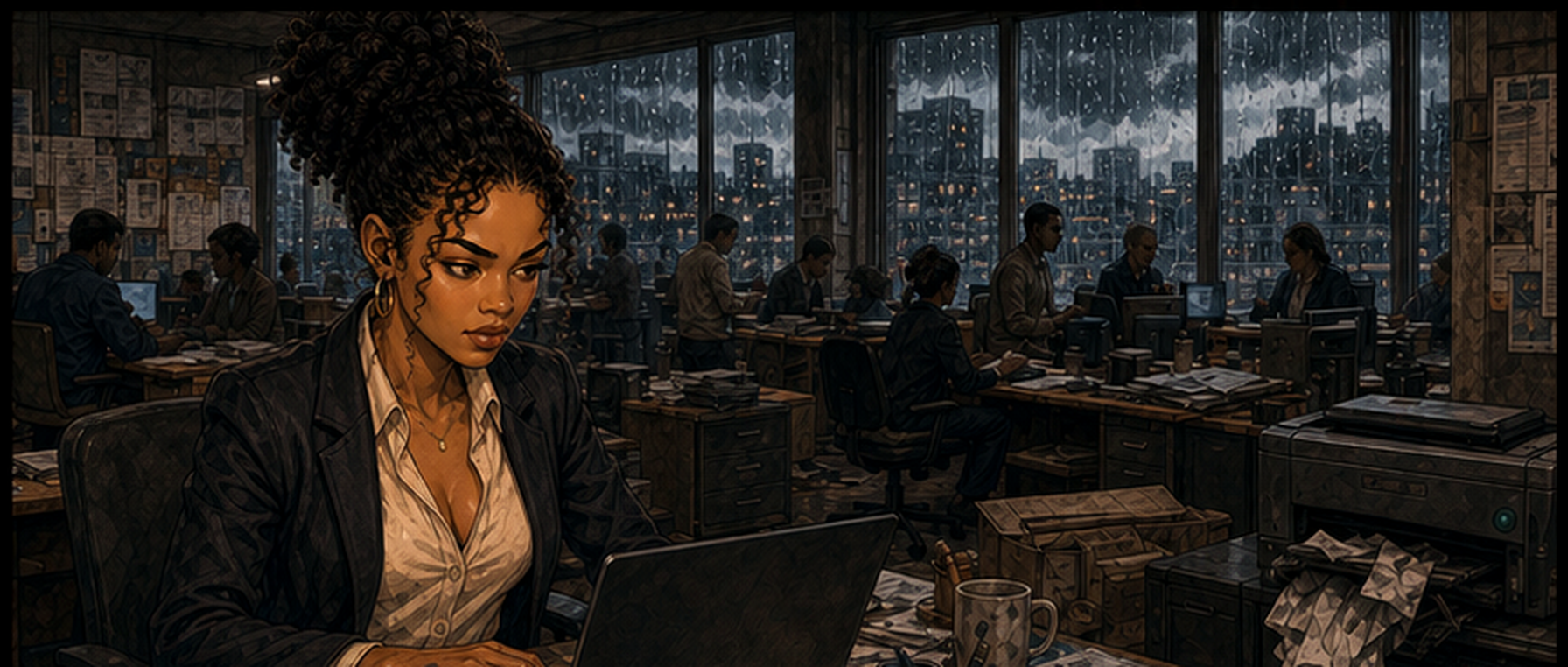
Lindi's Lead
Zeth Mnguni - Genesis
Chapter 6: Lindi's Lead
The attachment was gone.
The email remained, which made it worse.
If the whole message had disappeared, Lindi Dlamini could have called it theft and allowed herself the comfort of anger. Theft had shape. Theft had hands. Theft was a person taking something and leaving absence behind.
This was cleaner.
The complaint thread still sat in the newsroom inbox under a subject line so dull it had almost survived the morning:
Public records pilot - urgent concern
The sender name was still there.
Malusi Phiri
The timestamp was still there.
22:43
The footer was still there too, because nothing official in South Africa could fall apart without leaving a disclaimer behind to pretend order had attended the meeting.
But the body of the email had been reduced to one sentence:
Please see attached.
There was no attachment.
Lindi clicked the paperclip icon again.
Nothing.
She clicked the thread history.
Nothing.
She opened the raw header view, because ordinary people prayed and journalists opened headers.
The newsroom around her kept moving with the half-broken energy of a place that was always one printer jam away from confession. Phones rang. Keyboards rattled. A junior reporter near sports argued with somebody about whether a quote could be off the record after it had already been shouted in public. Rain touched the Braamfontein windows softly, not enough to clean the glass, only enough to make Johannesburg look undecided.
Lindi leaned closer to the screen.
At 22:43 the complaint had arrived with an attachment. She knew that much because she had seen the paperclip on her phone the night before, standing in a Pick n Pay queue with a loaf of bread under one arm and her battery on nine percent. She had almost opened it there. Then the signal had dropped, the cashier had asked whether she wanted a plastic bag, and Lindi had done the responsible thing.
She had told herself she would open it properly at work.
Responsible, she was learning, was where evidence went to die.
At 06:12 the thread still showed a paperclip.
At 06:14 the thread preview changed to:
Please see attached.
At 06:17 her reply to Malusi Phiri bounced.
Lindi checked the bounce again.
Mailbox unavailable.
Not full.
Not delayed.
Unavailable.
"Dlamini."
Jonas Maseko's voice came from behind a pile of old newspapers, legal warnings, and one mug that had become a workplace hazard through loyalty alone.
Lindi did not turn.
"I need mail logs."
"Good morning to you too."
"Morning. I need mail logs."
Maseko came to stand beside her desk.
He had been a proper reporter before budgets taught him caution and management taught him phrases like liability exposure. He still carried the body language of a man who wanted to run toward trouble. His face now belonged to a man responsible for other people's salaries.
"What am I looking at?" he asked.
"A complaint that arrived last night with an attachment."
"Where is the attachment?"
"Exactly."
Maseko bent toward the monitor and read the message.
"Maybe it failed."
"It did not fail. It arrived."
"You saw the file?"
"I saw the paperclip."
"That is not seeing the file."
"It is seeing the system admit a file existed."
"That sentence is not going to impress a lawyer."
"One day I want somebody to believe in me the way editors believe in technical errors."
Maseko did not smile.
That worried her.
When Maseko refused to laugh, he was either tired, frightened, or already calculating how expensive the truth might be.
"Who sent it?" he asked.
"Malusi Phiri. Civil Records Support."
Maseko's mouth tightened around the name of the company.
"Contractor?"
"Looks like it. Maybe public records pilot, maybe archive-room upgrades, maybe some tender nobody wanted us to understand before breakfast."
"You have documents?"
"I had documents."
"No, you had a paperclip."
"The man sent a complaint and now his mailbox is dead."
"People resign."
"At 06:17?"
"People resign badly."
"He also is not answering his phone."
Maseko straightened.
That landed.
"You called him?"
"Three times."
"And?"
"Off. Not voicemail. Off."
"Lindi."
"Don't use the voice."
"There is no story without proof."
"There was proof."
"There is no proof now."
"That is the story."
"No. That is a feeling with a deadline."
The printer across the room made a hard choking sound and stopped. Somebody at business desk said, "Again?" with the sorrow of a person addressing family.
Lindi opened another part of the raw header and scrolled.
Most of it was ugly in the ordinary way. Servers. Transfer paths. Authentication strings. Little signs of digital life moving through places no one on the news desk had ever been paid enough to visit.
Then she saw it.
One line.
Short enough to be deliberate.
X-Route-Policy: civic-media-risk / monitor-only
She copied it into her notebook by hand.
Maseko leaned closer.
"What is that?"
"A crumb."
"A crumb is not a court defence."
"I am not trying to go to court. I am trying to phone a source before he becomes a paragraph in someone else's denial. Or worse, in an obituary."
Maseko looked at her then.
Properly.
"Careful."
"That is what people say when they mean quiet."
"No. Quiet is what lawyers ask for. Careful is what old reporters ask for when young reporters remind them of themselves before medical aid."
Lindi sat back.
On the television bolted high in the newsroom corner, Parliament footage rolled with the sound muted. The lower third mentioned the State Records Protection Bill again. Men in suits moved their mouths under captions about national security, classified archives, responsible disclosure, dangerous leaks.
The same words had been on screen all week.
The country was arguing about who had the right to know things.
Lindi mouthed the sentence without sound.
Everything affected everyone.
In the newsroom, a complaint about records had arrived with proof and woken up without it.
That was not poetry.
That was timing.
"Let me call IT," Lindi said.
"No."
"Jonas."
"Not yet."
"Why?"
"Because if this touches the Bill, or Apex, or any of those public-sector security contractors, the first question will be why you were looking at headers instead of escalating properly."
"Escalating to who?"
"Me."
"I am escalating to you."
"With that face."
"This is my normal face."
"That is why we have problems."
He rubbed his eyes with two fingers.
"Call the source. Quietly. No promises. No accusations. No email trail. And do not put State Records Protection Bill and missing attachment in the same paragraph unless you want a letter from somebody called Pieter who charges by the comma."
"What if the man is called Elias?"
Maseko stopped.
"Why Elias?"
Lindi closed the header window one line too late.
Maseko saw it.
He did not read fast enough to catch the route policy, but he saw the shape of her hiding.
"No reason," she said.
"That is the most expensive phrase in journalism."
"You taught me."
"Badly."
He walked away before affection could weaken his authority.
Lindi waited until he was speaking to the printer like a hostage negotiator, then pulled open the bottom drawer of her desk.
The drawer stuck halfway.
It always stuck halfway.
Lindi lifted it, jerked it once, and reached beneath a packet of stale mints, two old press badges, and a lipstick she had bought during an emotional crisis and never trusted in public.
The folder was labelled:
useful people
Not sources.
Sources were sacred.
Useful people were different. They knew where things moved. Which courier came early. Which clerk lied badly. Which security guard smoked near which gate. Which taxi driver had seen a politician's nephew at the wrong door. Which man at Bree sold phone chargers, gossip, and sometimes the truth if the price included respect.
Lindi had been collecting useful people before she had language for journalism.
At eleven she found a neighbour's missing bicycle because the thief had painted only one tyre.
At twelve she proved Mr Mokoena from number 17 was not selling drugs. He was only cheating with somebody's aunt and carrying on like perfume was contraband.
At fifteen she filmed the unfinished children's park near her school, followed invoices to a councillor's cousin, and put the whole thing on YouTube with background music stolen from her brother's phone.
Almost a hundred thousand subscribers arrived in less than a week.
After that came fake charities, school-feeding invoices, missing library computers, and one police captain who smiled on camera right before discovering that comments sections could also investigate.
The channel had later wandered close to a million followers.
Not famous-famous.
Inconvenient famous.
Good cops watched quietly when a case stalled. Bad cops pretended not to know her. Strangers stared just long enough for her to decide whether she needed to leave.
University had slowed the channel. Assignments, fees, fatigue, and the need for an actual job had trained the algorithm to forget her. Lindi hated that when rent was due. She liked it when she had to sit in cafes near buildings where people did not want YouTube detectives asking questions.
She found the card.
Sipho Ndlovu
Bree.
Chargers.
Drivers.
Never pay. Full story upfront.
Sipho answered on the second ring.
"Dlamini, if you need a charger, prices went up. Eskom has chosen violence."
"I need a person."
"People are more expensive than chargers."
"Malusi Phiri. Civil Records Support. I need to know who can find him without making noise."
Sipho sucked his teeth.
The sound told her more than words.
"Call KB."
"Who is KB?"
"Kabelo Motsepe. He is the guy who knows everything from CBD to the whole south of Johannesburg. Even before you know, he knows."
"Sipho, you owe me for saving your marriage and keeping your wife and kids with you. Do not forget I still have the evidence to change that."
"Awu, man, sistela. Trust me, this guy is solid."
"He is not one of your junkies you send to lie to me so they can get money for cheap drugs?"
"No, no."
"Do you trust him?"
"With as much as trust is worth in the city of gold. Trust belongs to the highest bidder."
"Send the number."
"In lobola negotiations, your wife's uncles do not say a word until ukhiphe ivula mlomo. Consider me the vula mlomo. Noma ungafaka 350, I soften him up for you first."
"Yazi, I bumped into Candy last week. She said you disappeared. She does not see you anymore, and you still owe her morning-after money."
"Lindi."
"Kambe, what is your wife's number again? I have images on my phone. I am sure she would love to see."
"Okay, okay, bengidlala, sistela. I will send it now and call him so he answers, because that boy's Truecaller is ahead of time. I think it is that brother of his, or cousin, or adopted- angazi."
"Sipho."
"Okay, okay. Sending. But he is a better negotiator than me. I still owe him like five million drillion from our last deal."
"Five million drillion?"
"Maybe seven hundred. Numbers are emotional."
The number arrived before the call ended.
Lindi did not dial immediately.
For a moment, she only looked at the new contact. Every new contact in journalism meant one of two things if the day was honest about itself: evidence, or a coffin. She wondered which one Kabelo Motsepe intended to become.
Then she dialed.
No answer.
She dialed again.
No answer.
Two minutes passed.
Enough time for Sipho to warn him. Enough time for KB to decide if a journalist was worth damaging his morning.
On the third try, he answered on the fifth ring.
There was wind in the line, then shouting, then a short burst of music before a door shut and the noise fell away.
"Ngitshelwa ukuthi kunosisi ofuna ukungibulala?"
"Lutho, bhuti wami. Ngabe ngikhuluma noKB?"
Silence.
"Kabelo?"
"Sawubona."
"Sawubona, KB."
"Khuluma, sisi. Time is money, money is time. I don't smoke, I don't drink, I don't do crime, but somehow Sipho still sends me problems with press cards. What can I do for you, or you for me? Uma umuhle, maybe we can both help each other. Uma uyinkinga, ngitshele manje."
"I need a favour."
"Yoh. Ama-favour ase out of stock okwamanje. But for a small finder's fee I can even get you three. Like Aladdin's genie, but with better fuel economy."
"Awume, bhuti wami. Nami ngisaphanda. I am still starting out properly, and newspapers pay like they are doing me a spiritual favour. I can organise upetrol omncane, but please give all discounts where possible."
"You are negotiating before telling me what I am surviving."
"I am saying being owed by me can come in handy one day."
"Khuluma, ngilale."
"Do you know anyone connected to Civil Records Support?"
The last bit of wind disappeared from his side.
"Ngazi abantu abaningi, mntaka ma. I even know Jesus. You have not said anything yet. I said khuluma."
"Do you know a gentleman named Malusi Phiri? He works-"
"At archives," KB said. "Ngiyamazi, sisi. Yini, is he also not answering his phone?"
Lindi sat straighter.
"What do you mean also?"
"Not so long ago, somebody claiming to be an investigator asked me about a person I know at Civil Records Support. The investigator did not pay petrol. Already suspicious. Then I recently saw both of them on missing posters."
"Both of them?"
"For a journalist, u-slow kancane. Yebo, I know Malusi. I was hoping you would arrive with more concern."
"Who was the investigator?"
"I do not collect unpaid men's CVs."
"KB."
"Rendani Nkosi."
Lindi's pen stopped moving.
Rendani Nkosi had been in her notes since November. Older. Better sourced. The kind of investigative reporter who could make a minister's spokesperson develop flu over the phone. He had been digging around archive-security tenders and ghost protection contracts long before Lindi found the phrase public records pilot.
She had called his office once. He had not called back.
"When did you see the posters?" she asked.
"Yesterday. Bree side."
"Missing-missing?"
"On paper, sisi. Not WhatsApp gossip. Missing."
The newsroom noise came back around her all at once.
Phones. Printer. Maseko's low voice.
People doing the normal work of the day while two names moved closer to a hole.
"I am not saying stop," KB said. "I am saying be careful you do not get stopped."
"Malusi sent us a complaint last night. The attachment disappeared before morning."
For once, KB did not answer quickly.
"Disappeared how?"
"Clean. Body reduced. Attachment gone. Mailbox unavailable."
"You want me to find him?"
"I want to know whether he is hiding, scared, drunk, dead, or pretending to be one of those because someone told him to."
"Sho. You people say good morning with knives."
"Can your people listen?"
"For petrol, people can listen to thunder."
"I can pay petrol."
"Good. Because if Malusi and Rendani are both near the same hole, I am not sending a driver blind."
"No blind drivers."
"What else?"
Lindi looked down at the copied header.
X-Route-Policy: civic-media-risk / monitor-only
Below it, another fragment she had pulled from the routing ugliness:
Migrated-Legacy-Hold: R_NKOSI
"I need to know whether Apex Sentinel Systems touches this records pilot."
The line went so quiet she thought the call had dropped.
"Say that company again."
"Apex Sentinel Systems."
On KB's side, something metal clinked.
"Why Apex?"
"Their name keeps standing close to places evidence disappears."
"Sisi."
"I know."
"No. You don't know. You are saying the words. You do not know yet."
"Then help me know before Malusi becomes another poster."
KB breathed through his nose.
"My boy started at Apex this week."
Lindi's pen hovered over the paper.
"Your boy?"
"Zeth."
The name hit before she invited it.
Dark suit.
Jacket over arm.
Visitor sticker jokes.
A young man in the Apex lobby looking at arrows as if he expected them to lie.
"Zeth Mnguni?" she said.
KB's voice cooled.
"How do you know his surname?"
"His badge."
"Where did you see his badge?"
"At Apex."
"Define at Apex."
"Lobby."
"Define lobby."
"I was being received."
"People who say being received usually have lies in their shoes."
"He insulted my visitor sticker."
KB made a sound that was half laugh, half warning.
"That is definitely him."
"I need to speak to him."
"No."
"KB-"
"No, sisi. Zeth is not one of your leads. He is not a number from Sipho. He is my person."
That landed cleanly.
Good, Lindi thought.
Not because it helped her.
Because it told her what kind of man was standing between her and the intern from the lobby.
"I am not asking you to hand him over," she said. "I am asking you to warn him. If these phrases are ordinary, he can tell you they are ordinary and I will look elsewhere."
"And if they are not ordinary?"
"Then someone is deleting complaints before journalists receive them, and two men connected to the same records story may already be missing."
KB said nothing.
This silence did not perform.
It checked locks.
"Send me the phrases," he said.
"No."
"Sharp. Say them once."
"Civic-media-risk. Monitor-only. Migrated legacy hold. R_NKOSI."
"R_NKOSI like Rendani?"
"I think so."
"I will call him."
"Give him my number."
"I will call him first. If he wants your number, he will get it."
"Public place," she said.
"Daylight."
"That was my plan."
"I mean real daylight. Not dark corners, not dramatic parking lots, not meet me behind the thing like TV people."
Lindi looked at the empty place in the email where proof had been.
"Tell him the woman from the lobby says it matters."
The call ended.
Lindi sat with the phone in her hand.
Across the newsroom, Maseko looked at her.
She lifted one finger.
One minute.
One lead.
One missing attachment turning the whole day in its mouth.
Zeth ignored KB's first call because he was in a compliance session watching a man in a grey suit explain password hygiene as if sin had begun with lowercase letters.
He ignored the second call because Ruan glanced at the vibrating phone, saw KB's name, and mouthed:
girlfriend?
Zeth turned the screen face down.
Ruan mouthed:
baby mama?
Zeth wrote one word in the corner of his notebook and angled it toward him.
Focus.
Ruan read it, nodded gravely, and wrote under it:
Unrealistic.
The compliance analyst clicked to the next slide.
PASSWORD REUSE IS A HUMAN VULNERABILITY
Ruan underlined human and drew a small grave beside it.
Zeth should not have smiled.
He smiled anyway.
Then his phone vibrated a third time.
This time KB sent a message.
Answer before I tell Gogo you are too corporate for family.
Below it came another message.
Also there is a journalist problem.
Zeth stopped smiling.
Journalist problem.
That was not a phrase with clean edges.
At the break, he stepped into the corridor near the water cooler and called back.
KB answered too quickly.
"Finally, Mr Apex."
"Is Gogo okay?"
"Gogo is watching a soapie and judging a woman for forgiving a man with no job. She is fine."
Zeth closed his eyes for half a second.
"Then why are you calling like there is blood?"
"You have been busy, heh? Too busy to answer. Women are calling me left, right, and centre asking for you."
"What are you on about, KB?"
"Uyamazi uLindi?"
"Lindi who?"
"Lindi the journalist."
"Hayi, bafo, angimazi uLindi. I have to go if Gogo is fine."
"Woah. Wajaha kangaka yini? Is there a stampede at Apex?"
"I am at work."
"Then stand there with respect. Ngisho uLindi mina. Umuntu wakho you did not tell me about. She says you met in the lobby, something about stickers and arrows."
Zeth went still.
A woman from finance passed carrying tea and a muffin. He waited until her footsteps were gone.
"Oh," he said.
"Oh?"
"You mean the one with the crooked visitor sticker."
"I do not know if it was blue, green, or orange. I was not there doing colour theory. All I know is I got a call from someone I do not like getting calls from, saying someone was going to call me. Fede sharp, le'ngane rings me asking about Malusi."
"Malusi who?"
"Malusi Phiri."
"The archives guy who keeps borrowing money from you?"
"That one."
"Manje mina ngingenaphi?"
"Because uyaspeeda, uyaphapha. I was still explaining."
"Explain faster."
"She did not want to give me the whole thing like elokhu ezenza uJames Bond lah. But she mentioned Apex. I mentioned you. Then she mentioned bumping into you and thinks you can help."
"Help with what?"
"A complaint email disappeared. Attachment gone. Sender missing. Malusi missing-missing, not I owe KB forty rand missing. And there was a phrase."
Zeth looked toward the secure development doors.
Mira was not there.
Sizwe was not there.
That did not make the corridor private.
"What phrase?"
"Civic-media-risk."
The words moved through Zeth's body before he could stop them.
Media-risk.
From the compliance briefing.
From the slide.
From the place where public-sector data handling had sounded too polished to be harmless.
"Anything else?" he asked.
"Monitor-only. Migrated legacy hold. R_NKOSI."
Zeth's hand closed around the phone.
Not enough to crack it.
Enough to hurt.
R_NKOSI.
He saw the project tree again.
Grey folder.
Locked icon.
`CIVIC-BBX`
Then a file fragment before the screen corrected itself.
`R_NKOSI.watch`
"Zeth?"
"Where did she get those?"
"From an email header, she says."
"Do not send them to me."
"I did not."
"Do not WhatsApp them."
"I am handsome, not stupid."
"This is not funny."
"I know. That is why I am putting jokes in front of it before it becomes expensive."
Zeth looked down the corridor again.
The water cooler bubbled once.
Someone inside the training room laughed at something that could not possibly deserve laughter.
"I cannot get involved," Zeth said.
"You do not have to marry the problem. Just look at it."
"That is how people get married to problems."
KB went quiet.
Then, without joke, he said, "She says the source might be in danger."
Zeth hated him for saying it properly.
Quietly.
Like truth.
"Lindi is the woman with the sticker," Zeth said.
"Yebo. The sticker one."
"And she said she is a journalist."
"Haibo, mfethu, I did not ask for a CV. Kanti akuyona yini intombi yakho?"
"Eish, KB."
The lobby came back to him too clearly.
Rude to trust stickers before people.
"I met her," Zeth said.
"She said. You were not a gentleman. I raised you better."
"She said that?"
"Ngiyadlala. She said you had jokes for each other. You sounded worried there. Yini, uyamfuna yini?"
"Eish, shut up. And you did not raise me."
"Ungrateful."
"Where does she want to meet?"
KB's voice changed by half a degree.
"Public place. Braam. Daylight. I told her you are trying to behave."
"I am."
"I know. That is why I trust you with someone who isn't."
"KB."
"One conversation. If it is nothing, it is nothing."
Zeth thought of Sizwe in the stairwell.
Do not confuse noticing with understanding.
He thought of Mira's hand on the mouse.
Forget what you saw.
He thought of the locked folder appearing long enough to know his name was not the only thing Apex knew too quickly.
"Send the address," he said.
"Already sent."
"And KB?"
"Yes?"
"If this is dangerous, stay away from it."
KB laughed once.
"My guy. She found me through Sipho from Bree. We are already sitting in the cheap seats of danger."
He hung up.
Zeth lowered the phone.
Behind him, the training-room door opened. Ruan stepped out with two paper cups of water and a face arranged for gossip.
"That sounded serious."
"It was KB."
"Ah. Baby mama, then."
"I will pour water on you."
"In this economy? Wasteful."
Ruan handed him one cup.
Then his expression shifted.
Not much.
Enough.
"You good?"
"I am fine."
"That is office for no."
"Then I am office fine."
Ruan accepted that with the restraint of a man raised among people who hid family problems behind tennis schedules.
"If you need an alibi," he said, "I was with you discussing password hygiene and the emotional collapse of modern man."
Zeth looked at him.
"Why would I need an alibi?"
Ruan sipped his water.
"Because you have the face again."
Braamfontein in the early afternoon smelled like wet concrete, frying oil, exhaust, and student ambition.
Lindi chose a cafe two streets from the newsroom, close enough that she could return quickly, far enough that Maseko could pretend not to know where she was.
The place had mismatched chairs, a chalkboard menu with three spelling mistakes, and a barista who looked personally offended by milk.
Good.
Perfect furniture made people perform.
She took the table near the window with her back to the wall.
Then she noticed she had done that and laughed at herself once.
Zeth arrived four minutes early.
Of course he did.
He stood just inside the door for half a beat, scanning before pretending he had not scanned. White patterned shirt. Dark trousers. No tie. No jacket. The suit had retreated, but it still lived in the careful way he carried his shoulders.
He saw her.
His face did three things quickly.
Recognition.
Suspicion.
Then the office mask.
Lindi lifted two fingers.
He came over.
"Why are you sitting like the walls are about to testify?" he asked.
"Why are you overdressed for a cafe with three spelling mistakes on the menu?"
"For this tavern? Definitely. This place is top class. You really know how to sweep a boy off his feet."
"You wish."
"You invited me."
"To ask questions."
"Same family."
She looked at the chair opposite her.
"Sit down, please."
It came out sterner than she meant.
Fine.
There was something else under it, something with a pulse, and she did not trust it around a missing man.
Zeth sat.
Not too close.
Not too far.
Careful.
Everything about him was careful except his eyes. His eyes kept arriving before the rest of him had approved the trip.
The barista shouted a name that belonged to nobody in the cafe. Nobody reacted. Johannesburg had prepared them for incorrect announcements.
Lindi opened her notebook.
Zeth looked at it but did not lean forward.
"Before you show me anything," he said, "I need to be clear. I am an intern. I cannot investigate Apex for you. I cannot touch their systems. I cannot download files. I cannot confirm internal information."
"That was a complete denial for a question I have not asked."
"Good. Saves time."
"Do you always begin conversations by disappointing people?"
"Only when KB arranges them."
"Fair. But I could sense you guys are close."
Zeth said nothing.
The silence was not rude.
It was locked.
Lindi understood it before she could resent it. KB had drivers, routes, favours, debts, and the sort of knowledge that could become dangerous if described to the wrong person. Zeth was not going to explain him to a journalist he had met once in a lobby.
She cleared her throat.
"Okay," she said.
Then she turned the notebook toward him.
Not her laptop.
Paper.
Old weapon.
Zeth read the copied lines.
His face did not change until the third one.
That was when she knew.
Not proof.
Recognition.
He looked again at the first line.
X-Route-Policy: civic-media-risk / monitor-only
Then the second.
Migrated-Legacy-Hold: R_NKOSI
His eyes stayed there one fraction too long.
Lindi rested her fingers on the notebook edge.
"Ordinary?"
"No."
The answer came out before he could dress it.
He saw that and sat back.
"I mean, no, not ordinary newsroom language."
"I did not ask about newsroom language."
"You asked ordinary."
"And you answered before deciding which kind of ordinary to hide behind."
He looked at her properly then.
Not friendly.
Not unfriendly.
Interested in the way a locked door is interested in a key.
"Who is R Nkosi?" he asked.
"Rendani Nkosi. Investigative reporter. He has been digging around archive-security tenders for months. He missed a meeting yesterday. His phone is off. KB says Rendani asked about Malusi before the complaint reached us. Now Malusi is gone quiet too."
"Missing?"
"Not confirmed."
"That is not the same as no."
"Exactly."
The cafe noise moved around them. Cups. Rain. A taxi hooting outside with deep spiritual commitment.
"Why were you at Apex?" Zeth asked.
Lindi smiled once.
"Beautiful. You jumped the fence."
"Why were you at Apex?"
"I had a meeting."
"With who?"
"Media Liaison."
"Media Liaison was not on the directory."
"You noticed."
"You photographed the directory."
"You noticed that too."
"You were angled toward Records Intake."
This time the smile left her.
Not because he had caught her.
Because he had kept it.
Yesterday, and the detail was still sitting in him like furniture.
"A source said public-sector records were moving through Apex before the pilot was public," she said. "I wanted to know what doors existed."
"Seeing a door is not permission."
He said it too fast.
Not his sentence.
Someone had handed it to him recently and it still had the warmth of another voice.
Lindi stored that.
"No," she said. "But if a public record needs a private corridor, I want to know why."
Zeth looked toward the window.
A student in a red hoodie ran through the rain with a plastic packet over his head. A woman under an umbrella shouted at a taxi driver who seemed unavailable for emotional growth.
"This can get you sued," Zeth said.
"Most useful work can."
"Or worse."
"That was true before I met you."
"You did not meet me. You were documenting a wall."
"You noticed the wall."
He looked back despite himself.
For one second, danger loosened.
Not gone.
Loose enough for both of them to feel the mistake of enjoying it.
Lindi opened the notebook again.
"I need to know if those phrases sound like normal mail security. Civic-media-risk. Monitor-only. Migrated legacy hold."
"No."
"Do they sound like Apex?"
Silence.
There it was.
The place where he could lie.
He did not lie quickly. That gave her more hope than it should have.
"They sound like systems built by people who do not want non-technical staff asking follow-up questions," he said.
"That is not an answer."
"It is the answer I can give."
"You have been there barely two days and already they taught you to talk around a room."
Zeth's face tightened.
For a moment, she thought she had pushed too hard.
Then he said, quietly, "Someone warned me."
She heard the shape under it.
Not policy.
A person.
"Good warning?"
"Not comforting."
"Those are usually the ones you remember."
He studied her.
"You are not scared enough."
Lindi almost laughed.
Wrong sound.
"You think because I am talking, I am not scared?"
He said nothing.
"I am scared all the time," she said. "But if I wait for fear to leave before I move, then fear is in charge. My mother did not raise me to be managed by a feeling."
That reached him.
She saw it.
Not attraction first.
Recognition.
Better.
"What do you want from me?" he asked.
"One thing."
"People say one thing when they mean a staircase."
"I want to know whether R_NKOSI is being watched by a system connected to Apex or the records pilot. Not your passwords. Not your career. Not some movie hacking scene. One check. If it is nothing, I follow another lead."
"And if it is not nothing?"
"Then I come back."
"That is what I thought."
"But not today," she said. "Today I am asking for one check."
He breathed out through his nose.
Almost a laugh.
"I cannot search internal systems."
"I did not ask you to."
"I cannot confirm internal flags."
"I did not ask you to."
"I cannot be your source."
"You are not that generous."
His eyes came up.
Sharp.
"Then what am I?"
Lindi closed the notebook.
"A person who noticed the arrows were lying before I told him which way they pointed."
The answer sat between them.
Outside, rain thickened.
Inside, the barista finally found the owner of the abandoned coffee and handed it over like justice had been delayed.
Zeth looked at his phone.
Then the door.
Then the notebook.
Work.
Exit.
Question.
She could see him choosing the lie before he spoke.
"I will check one thing," he said.
"Public sources only," he added.
"Of course."
"No Apex systems."
"Of course."
"No files."
"Of course."
"Stop saying of course like customs is checking your bag."
"Sorry."
"You are not sorry."
"No."
This time he smiled properly.
Quick.
Reluctant.
Too young for all the caution around it.
Lindi looked down first.
Not because she wanted to.
Because Malusi Phiri was missing, Rendani Nkosi was missing, and whatever Zeth Mnguni did when he smiled did not get to become the most important thing in the room.
She tore the page from her notebook and folded it once.
Zeth did not take it.
Good.
She placed it on the table between them.
"Memorise."
"That is dramatic."
"It is paper. Relax."
He looked at the lines.
Then away.
"Civic-media-risk," he said.
"Monitor-only."
"Migrated legacy hold."
"R_NKOSI."
He closed his eyes for half a second.
Opened them.
"Got it."
Lindi picked up the paper and dropped it into her coffee.
Ink bled into brown water.
Zeth stared at her.
"That was unnecessary."
"But stylish."
"Wasteful."
"Newsroom coffee. It had already failed."
He shook his head.
"KB was right about you."
"What did he say?"
"Trouble."
"He said worse things before that."
"No," Zeth said. "He says that when he is worried."
Lindi's smile softened before she could stop it.
"He is a good contact."
"He is not a contact."
Fast.
Protective.
There.
Another door.
Lindi nodded.
"He is KB."
Zeth accepted that.
Barely.
But he accepted it.
His phone buzzed on the table.
He looked at the screen.
Whatever he saw closed him again.
"I have to go."
"Apex misses you?"
"Apex counts everything."
"Do they count coffee?"
"They would if they could turn it into a role."
She almost asked what that meant.
Then she remembered the rhythm in one of her old notes.
User.
Group.
Role.
Permission.
Resource.
She did not say it.
Not yet.
She was finally learning not every useful thing needed daylight at once.
Zeth stood.
He left money on the table for coffee he had not ordered.
"You did not drink anything," she said.
He looked around the cafe.
"They could use it."
He did not want to admit that he had felt the need to pay for her drink.
"Be careful," he said. "Maybe I will miss you."
He thought he was being sarcastic.
It came out heavy with meaning.
"You too," she said.
She ignored the joke.
Or whatever it had been.
He looked like he wanted to ask something else.
Maybe about Apex.
Maybe about Records Intake.
Maybe about why a journalist with a dead paperclip had called his best friend before lunch.
Instead he nodded once and stepped back into the rain.
Lindi watched him cross the street without running.
Of course he did not run.
Even in the rain, he made himself walk.
Zeth's phone buzzed before he reached the corner.
KB.
Did you behave?
Zeth looked back once.
Through the wet cafe window, Lindi was still at the table, notebook open, eyes lowered to the page as if staring hard enough could make the missing attachment return.
He typed:
Define behave.
Then:
She is trouble.
KB replied immediately.
Yoh.
Then:
Please don't get fired before you become rich.
Zeth almost typed:
No promises.
Instead he put the phone away.
He returned to Apex with rain on his shoulders and Lindi's phrases arranged behind his eyes like objects on a desk.
Civic-media-risk.
Monitor-only.
Migrated legacy hold.
R_NKOSI.
He did not write them down.
He did not open anything.
He did not search.
He sat through the rest of the afternoon and fixed a small validation bug in a form that did not care about journalists, missing attachments, fathers, or the fact that the word legacy had started following him around like a debt collector.
At five seventeen, Ruan rolled his chair closer.
"You are doing that thing where your silence becomes a meeting invite."
"I am working."
"You have been staring at the same semicolon for twenty seconds."
"It is suspicious."
"All semicolons are suspicious. That is not news."
Zeth saved the file.
"Are you going home?" he asked.
"Eventually," Ruan said. "My mother wants proof that employment did not kill me. I am deciding how dramatic to be."
"Tell her closed shoes were worn."
Ruan pointed at him.
"Exactly. She will weep."
Zeth logged off.
The system accepted the command.
Cleanly.
Systems were always cleanest when they were closing the door behind you.
He drove back to Maboneng through rain that made every traffic light look bruised. Taxis shouldered through lanes with religious confidence. Office workers stood under awnings pretending not to hate one another. A man sold umbrellas from a crate with the speed of someone who understood markets better than economists.
In the apartment, the couch waited where he had left it.
The mattress still leaned against the wall, wrapped in plastic.
Boxes stood around the room in KB's handwriting.
SHIRTS / DOCUMENTS / RANDOM
BOOKS / CABLES / MAYBE FOOD
IMPORTANT THINGS THAT ARE NOT MINE
Zeth put his bag down.
He changed out of the work shirt because it smelled like office rain and restraint.
He made noodles in a pot too small for dignity.
He ate standing at the counter because sitting made the apartment feel more permanent than he was ready to admit.
Then he took out his old laptop.
Not the Apex machine.
His own.
The one with a cracked hinge, a battery that would never last through load shedding, and a keyboard where the A key had gone shiny from years of being used more than money.
He placed it on the small table.
Plugged it in.
Waited while it complained itself awake.
He told himself he was not checking Apex.
That was true.
He told himself he was not investigating.
That depended on who was defining the word.
He searched public records pilot.
Too broad.
He added archive security tender.
News results. Old committee minutes. Procurement notices written in a language designed to make theft sound administrative.
He searched Civil Records Support.
A thin company page loaded slowly. Generic logo. Proud partners. Contact form. No staff list.
He searched Malusi Phiri.
Nothing useful.
He searched Rendani Nkosi.
There he was.
Columns.
Radio interviews.
One photograph of a man with tired eyes and a smile that looked like it had learned not to trust microphones.
No missing-person article.
Not yet.
Zeth searched the phrase exactly:
"civic-media-risk"
No results.
He searched:
"migrated legacy hold"
No results.
The apartment hummed around him.
Fridge.
Rain.
Distant music from another unit.
A lift moving somewhere behind the walls.
One check, he had said.
One phrase, he had meant.
He had checked two.
That was still close enough to honesty if a person was generous and no one was keeping logs.
His cursor blinked in the search bar.
Then he typed:
"R_NKOSI.watch"
No results.
He sat back.
That was the first thing he had searched that Lindi had not given him.
The room felt smaller after that.
Zeth opened a blank text file.
He did not name it evidence.
He did not name it investigation.
He did not name it Lindi.
He named it:
questions.txt
That felt safe enough to be a lie.
He typed four lines.
`R_NKOSI.watch`
`civic-media-risk`
`monitor-only`
`migrated legacy hold`
Then, below them:
`How does media-risk map to access control?`
The same question from the compliance briefing.
Same question.
Different room.
Homework never ends.
Zeth saved the file.
The laptop fan spun up, loud and tired.
Outside, Johannesburg kept moving through the rain, carrying secrets in taxis, inboxes, access cards, envelopes, and people who told themselves they were only checking one thing.
Zeth closed the laptop halfway.
Not fully.
The screen stayed lit in the narrow dark.
He told himself he could still stop.
The cursor blinked through the gap.
Once.
Twice.
Waiting.